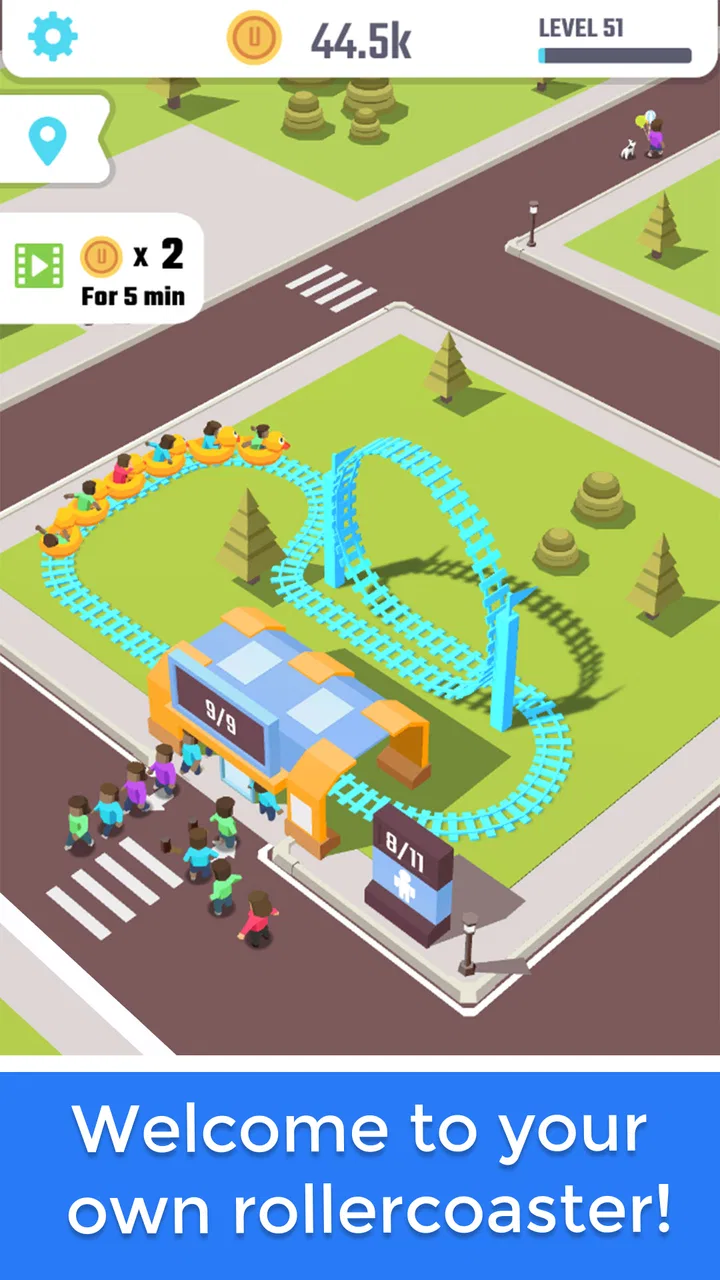
Idle Roller Coaster
- 4.7
- Rating
- 10.00M
- Installs
- Free
- Price

 Analysis by App-foxy
I spent time with Idle Roller Coaster as a casual strategy game, and my first impression was clear: it is built for people who enjoy watching a small amusement-park idea grow without needing to give it constant attention. The central appeal is easy to understand. You manage a roller-coaster park, make decisions that improve its progress, and return later to see how your work has developed. It is lighter than a traditional strategy game, but it still gives you enough choices to make each visit feel purposeful.
The game is free to start, rated for Everyone, and developed by Solid Games. It belongs to the idle strategy group, so the main question is not whether it has the deepest management model available on mobile. The better question is whether its relaxed rhythm, amusement-park theme, and gradual progression fit the way you like to play. In my experience, it works best as a game for short sessions, background progress, and small decisions rather than long, demanding campaigns.
What to consider before choosing this idle park game
The most important decision criterion is your preferred level of control. If you want a game that asks for constant movement, precise timing, or complicated battles, this is probably not the right direction. Idle Roller Coaster is more comfortable when you enjoy checking a project, improving it, collecting progress, and deciding what deserves attention next. The amusement-park setting gives those actions a friendlier personality than a plain business simulator.
You May Also Like

 Blood Strike: 2.5 Anniversary
Blood Strike’s Loadouts Turn Every Drop Into a Tactical Gamble
A close look at Blood Strike’s custom loadouts: how fast access to signature weapons reshapes its battle royale rhythm, rewards preparation, and narrows the gap between fights.

 Pandora - Music & Podcasts
Pandora’s Music Is Easy to Start, but Harder to Recover
Pandora’s strength is its low-effort path from a seed to a station. Its weak spot is how much confidence it asks you to place in connection, setup, and quiet recovery.

 8 Ball Pool
 Is Built on Rivalries, Rematches, and Routine
A close look at the rivalries, rematches, shared routines, and unanswered safety questions that turn a quick pool match into a persistent mobile community.

 Samsung Music
’s Quiet Strength Is Playing What You Already Own
Its reach comes less from spectacle than from dependable access to a personal library. That simplicity is both the app’s strongest retention engine and its ceiling.

 AccuWeather: Weather Radar
AccuWeather Review: A Quick, Clear Forecast for Everyday Decisions
For everyday plans, the best forecast is the one you can understand quickly. AccuWeather makes rain timing, radar, and local conditions easy to act on, with a few trade-offs.

 Hill Climb Racing
Why Hill Climb Racing Still Turns Crashes Into One More Run
A tiny car, a bumpy hill and one more upgrade: Hill Climb Racing keeps resurfacing because its simple chaos makes every near-miss feel personal.
More From Our News Desk



I also looked at how well the game fits ordinary daily routines. A realistic use case is a short break between tasks: I can open it, review what has accumulated, make an upgrade decision, and close it without feeling that I have abandoned a long match. That makes it a practical choice for commuting, waiting rooms, or the few minutes before bed. It does not demand the kind of uninterrupted concentration that many conventional strategy games require.
At the same time, idle design can be a weakness if you need constant novelty. The satisfaction comes from gradual improvement, not from mastering a complicated map or outsmarting another player every minute. Some players will find that calming; others may interpret it as repetitive. Before installing, I would ask myself whether I enjoy watching numbers and park activity build over time, or whether I need a stronger sense of immediate action.
The audience size suggests that the format has broad appeal. The game has a 4.7 average from around 104 thousand ratings and more than 10 million installs. Those figures do not make it automatically perfect for everyone, but they do show that the basic combination of idle progression and roller-coaster management has connected with a large mobile audience.
How the progression feels in everyday play
My preferred way to approach it is in small cycles. I open the park, collect whatever progress is ready, inspect the available improvements, and spend resources only after deciding what will help the next return. That last step matters. Idle games can tempt you to tap every available button immediately, but a little patience makes the management side more satisfying. I found it more enjoyable when I treated each visit as a quick planning session rather than a routine collection task.
One useful habit is to give each session a purpose. On one visit, I might focus on improving the part of the park that increases future momentum. On another, I might simply collect progress and leave, especially when I am busy. This prevents the game from becoming a checklist that I complete without thinking. It also makes the idle structure feel like a tool for flexible play instead of an obligation to return constantly.
The roller-coaster theme helps because the setting is more inviting than an abstract production screen. Even when the underlying activity is about growth and upgrades, the park gives the process a sense of place. I can imagine the attraction becoming busier and more successful, which makes gradual progress easier to follow. That atmosphere is one reason I would recommend it over a completely generic idle title to someone who wants a little personality around the management loop.
There is also a useful distinction between playing for progress and playing for entertainment. If I am looking for a quick distraction, I can make a few decisions and leave. If I am in the mood to optimize, I can think more carefully about what to improve first. The game accommodates both approaches, although the lighter approach is where it feels most natural.
Where Idle Roller Coaster performs best
The strongest part of the experience is its accessibility. You do not need to learn a large rulebook before understanding the basic goal. The amusement-park idea is immediately readable, and the idle format lets you enjoy progress even when you only have brief sessions. That combination makes it especially suitable for new strategy players who may find traditional management games intimidating.
I also think it succeeds as a low-pressure companion game. It can sit alongside more demanding games rather than replacing them. After playing something competitive, I appreciate opening a title that does not punish me for taking a break or require perfect attention. The park gives me a small project to maintain, but the tone remains relaxed.
Another advantage is the way the game turns waiting into part of the experience. Instead of treating time away as lost time, the idle structure gives me a reason to return. That can be satisfying when progress feels connected to earlier choices. The trade-off is that waiting only feels rewarding when the decisions around it remain meaningful, so players who want rapid, dramatic changes may eventually want a different kind of strategy game.
Its age rating of Everyone also makes the presentation approachable for a broad audience. I would still choose it based on play style rather than age alone, but the rating matches the friendly, uncomplicated concept. For a family tablet or a shared device, the theme is easier to recommend than a game built around darker subjects or intense competition.
Solid Games has kept the experience in the free-to-play mobile space. There are in-app purchases ranging from $2.99 to $9.99 per item, so the free entry point is convenient, while optional spending is part of the overall design. I prefer to decide in advance whether I am willing to spend anything. That simple boundary helps keep the game in its intended role as a casual pastime rather than turning every return visit into a purchase decision.
Small decisions that make a difference
A non-obvious strength is that the game rewards a deliberate return routine. I would not open it dozens of times just to chase every small update. A better workflow is to check it when I already have a natural pause in my day, review the park, and make one or two considered choices. This reduces the feeling of maintenance and makes the accumulated progress more noticeable.
Another practical tip is to avoid judging the game during the first few minutes. Idle strategy games often feel modest at the beginning because their appeal depends on seeing a cycle develop. I found it more useful to play through several return sessions before deciding whether the pace suited me. If the growing park still feels like busywork after that, the problem is probably not a lack of understanding; the format simply may not match my preferences.
I also recommend separating “I have resources available” from “I should spend them now.” In a game centered on gradual improvement, immediate spending is not always the most satisfying choice. I found that waiting briefly and considering the next goal gave the park a clearer direction. This is a small change in behavior, but it makes the strategy element more visible.
Finally, I would treat notifications and return habits carefully if the device offers them. An idle game is most enjoyable when it fits around my day, not when it dictates my day. I prefer checking on my own schedule. That approach preserves the relaxed character of the game and prevents a gentle amusement-park simulator from becoming another source of digital pressure.
Where another strategy game may fit better
Idle Roller Coaster is not the best choice for every strategy player. If you want detailed construction planning, complex staff management, tightly balanced resources, or a large world to explore, a traditional theme-park management game may offer more control. Those alternatives can be better when your enjoyment comes from designing every part of an operation and dealing with the consequences of long-term decisions.
It may also disappoint players who want direct action. A roller coaster suggests speed and excitement, but the actual appeal here is the management loop rather than a ride-focused action experience. If you are searching for a game where you control a vehicle, react to hazards, or compete through quick reflexes, an arcade title will probably be a better fit.
Players who prefer competitive strategy should also compare carefully. An idle park game is mainly about personal progress and a relaxed routine, while competitive strategy games create tension through opponents, rankings, or timed decisions. Neither approach is automatically superior. I would choose this one when I want control over my pace, and choose a competitive alternative when I want every decision to feel urgent.
There is a similar trade-off with story-driven games. The amusement-park theme gives the experience character, but it is not the same as following a deep narrative with developed characters and dramatic turning points. If story is the reason I play, I would look elsewhere. If I want a pleasant setting around incremental management, this game makes more sense.
The game’s current version is 3.1.6 and it requires Android 6.0 or later. That makes device compatibility worth checking before downloading, particularly if I am using an older phone or tablet. The game is available at no upfront price, but I would still consider whether its optional purchases suit my budget and whether I am comfortable with the free-to-play structure before committing to long-term play.
The real cost of switching from another idle game
Switching to this game is easy if I am only looking for a fresh theme and a different progression loop. I do not need to carry over knowledge from a complex strategy system, and the roller-coaster setting makes the change feel distinct from fantasy kingdoms, farms, or abstract factories. The low entry barrier is a genuine benefit for someone who wants to try something new without studying advanced mechanics first.
The larger cost is time and attention. Any idle game asks me to invest in a new rhythm: learn what to prioritize, discover how quickly progress feels satisfying, and decide how often I want to return. If I already have an idle title that fits perfectly into my routine, this one needs to offer enough amusement-park personality to justify that adjustment. I would not switch simply because it is free; I would switch because the theme and pace appeal to me more.
There is also a psychological cost to starting over. Progress in an idle game is part of its reward, so leaving an established park can feel like giving up momentum. For that reason, I would try Idle Roller Coaster during a period when I want a relaxed secondary game, rather than deleting a favorite title immediately. A few short sessions are enough to see whether the park’s progression feels more enjoyable than the routine I already have.
Spending deserves the same caution. Since optional items can cost between $2.99 and $9.99, I would avoid buying anything until I know that I like the core loop without it. The free starting point makes that test possible. If the game remains enjoyable without spending, purchases can be considered as optional support or convenience rather than a requirement for deciding whether the game belongs on my device.
Who should play it and who should skip it
I would recommend this game to someone who enjoys incremental progress, colorful management themes, and short sessions that can be paused at any time. It is a good match for a player who wants a strategy label without the pressure of a long competitive match. It also suits people who like returning to a project and seeing that earlier choices have continued to matter.
I would be more cautious recommending it to someone who needs constant interaction. If tapping through improvements and checking a growing park starts to feel repetitive, the idle structure will not suddenly become a deep real-time strategy system. Likewise, players who want extensive customization or a detailed simulation should look toward more involved management alternatives.
For me, the best use case is as a calm game between larger commitments. I can play it while waiting for an appointment, during a short lunch break, or at the end of the day when I want a little progress without a demanding challenge. The fact that it is free to begin makes that experiment easy, while the Everyone rating keeps the concept broadly approachable.
After spending time with it, my recommendation is straightforward: try it if the idea of building a roller-coaster park through relaxed, incremental decisions sounds appealing. Its best quality is the way it turns a few spare minutes into a small management routine without demanding full attention. I would not choose it as my only strategy game, but I would gladly keep it as a lighter alternative to more complicated park simulators or competitive titles.
Idle Roller Coaster works because it understands its lane. It is not trying to replace every kind of strategy experience; it offers a friendly idle park with an easy starting point and room for gradual engagement. If you want speed, deep simulation, or constant tactical pressure, choose another category. If you want a free amusement-park game that lets you make progress at your own pace, Solid Games’ release is an enjoyable option to test.
FAQs for Idle Roller Coaster
01What is the main objective of Idle Roller Coaster?
Idle Roller Coaster is a simulation game where players aim to build and manage a successful theme park. The primary objective is to expand the park by upgrading roller coasters, adding attractions, and enhancing facilities to attract more visitors and increase revenue. Players must strategically invest in improvements to maximize profits and advance through levels.
02Is an internet connection required to play Idle Roller Coaster?
Idle Roller Coaster can be played both online and offline, allowing flexibility for players on the go. While an internet connection enhances the experience with updates and online events, the core gameplay is accessible offline, ensuring continuous progress even without internet access.
03Are there in-app purchases in Idle Roller Coaster?
Yes, Idle Roller Coaster includes in-app purchases that allow players to buy virtual currency and special items. These purchases can speed up progress and unlock exclusive content. However, the game is designed to be enjoyable without spending money, making it possible to advance through regular gameplay.
04How does the idle feature work in Idle Roller Coaster?
The idle feature in Idle Roller Coaster allows players to continue earning revenue even when they are not actively playing the game. This means that the park generates income while the app is closed, enabling players to return to accumulated funds that can be used for further upgrades and expansions.
05What age group is Idle Roller Coaster suitable for?
Idle Roller Coaster is suitable for players aged 4 and up, making it a family-friendly game. Its simple mechanics and colorful graphics appeal to a wide audience, while the strategic elements provide depth for older players. Parents can feel confident allowing younger children to enjoy this entertaining simulation game.
Pros
- Engaging gameplay with minimal interaction.
- Visually appealing graphics and animations.
- Frequent updates with new content.
- User-friendly interface and controls.
- Offline play available for convenience.
Cons
- Can become repetitive over time.
- In-app purchases can be pricey.
- Requires patience for progression.
- Limited customization options.
- Advertisements can be intrusive.

Idle Roller Coaster
Gallery